

Democratic Republic of Congo Ebola Outbreak 2026
- Situation in Democratic Republic of Congo
- Red Cross Red Crescent response
- Canadian Red Cross response
- How you can help people impacted by the Ebola Outbreak in Democratic Republic of Congo
Situation in Democratic Republic of Congo
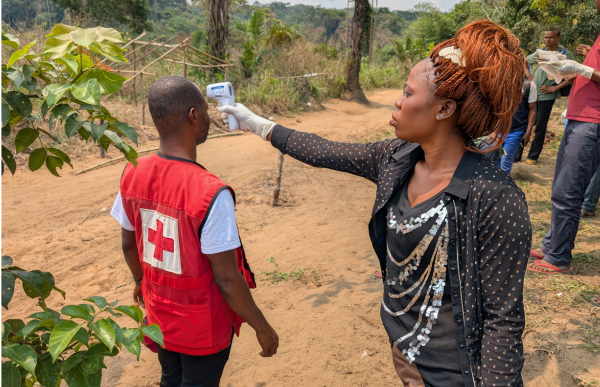
Photo: Red Cross of the Democratic Republic of the Congo / IFRC
An Ebola outbreak has been confirmed in Ituri Province in eastern Democratic Republic of Congo (DRC).
As of July 2026, the DRC has reported confirmed Ebola cases across five provinces: Ituri, North Kivu, South Kivu, Haut-Uélé and Tshopo.
The strain involved, Bundibugyo, currently has no approved vaccines or treatments. Ebola can spread rapidly if cases are not detected early, especially in remote communities that lack access to reliable information and healthcare.
To control the outbreak, it is critical to have active surveillance, early diagnosis, contact tracing, infection prevention, and clear communication with communities, along with safe and dignified burial practices. Safe and dignified burials are another critical line of defence as they are highly specialized procedure that prevent transmission from infectious bodies and ensure whenever possible the respect of local funeral practices. This allows families and communities to grieve their loved ones.
The risk of the disease spreading further is high because people continue to move between areas the healthcare system is already weakened, and DRC is experiencing conflict. Frontline health services are already under strain, with limited capacity to isolate and treat patients.
The situation is made more complex by the closeness to Uganda and South Sudan, meaning cross-border coordination is essential.
Red Cross Red Crescent response
The DRC Red Cross, supported by the International Federation of Red Cross and Red Crescent Societies (IFRC) and Red Cross Red Crescent Movement partners, is driving local readiness and response efforts, alongside health authorities.
Their work includes:
- Communicating with local communities about the risks of Ebola and how they can protect themselves and their loved ones
- Countering misinformation
- Encouraging people to seek care early when symptoms appear
- Community tracking
- Case surveillance reporting
- Safe and dignified burials, as the risk of transmission remains high following a person’s death due to Ebola.
- Working with the IFRC, the DRC Red Cross is mobilizing additional support from the region and global Red Cross Red Crescent Movement.
Canadian Red Cross response
The Canadian Red Cross, with support from the Government of Canada, is supporting Ebola response efforts, working closely with the DRC Red Cross and our Movement partners.
The Canadian Red Cross is providing essential supplies and personnel to support Safe and Dignified Burials. This is part of a larger public health deployment in coordination with the Norwegian Red Cross and French Red Cross.
The Safe and Dignified Burials support will focus on supporting the DRC Red Cross to scale up their safe and dignified burial activities, in close collaboration with the Ministry of Health. This includes monitoring and procuring personal protective equipment and other essential supplies, as well as training and supportive supervision.
Safe and Dignified Burial kits are a critical resource that help local response teams with highly specialized procedures that prevent transmission and ensure whenever possible the respect of local funeral practices.
These efforts balance public health needs with the importance of treated the deceased and their families with dignity, compassion and respect.
The Canadian Red Cross has deployed four additional humanitarian experts – for a total of seven – to support the IFRC responses in DRC and regionally from Kenya.
The Canadian Red Cross is grateful for Government of Canada’s contribution to support the local Red Cross emergency response in DRC.
The Canadian Red cross is well positioned to respond to the Current Ebola outbreak. The Canadian Red Cross has extensive experience responding to past Ebola outbreaks in the DRC, including in 2025, when we supported the mobilization of public health equipment, infection prevention and control training, and specialized personnel.
We remain in close contact with our Red Cross and Red Crescent partners as the situation evolves.
How you can help people impacted by the Ebola Outbreak in Democratic Republic of Congo
You can help support people hit hard by emergencies around the world, including the Ebola outbreak in the Democratic Republic of Congo, by donating to the International Disaster Relief Fund. Donations will help provide the survivors of disasters with urgently needed food, shelter, first aid, basic health care and medical supplies.
The funds allow us to respond within hours of an emergency, well before any money has been received from supporters. It also allows us to implement disaster preparedness programs to create stronger and more resilient communities.
For information on Ebola in Canada, please refer to the Public Health Agency of Canada.