

Breaking ribs during CPR and other fears
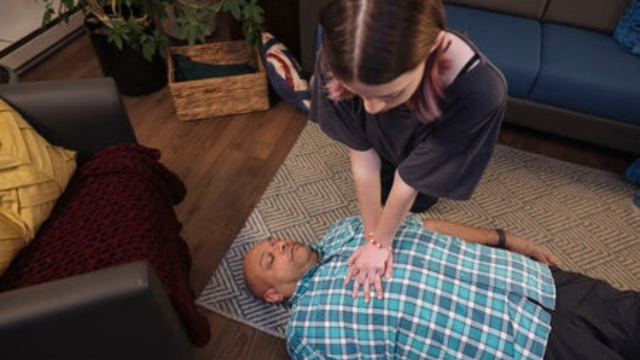 Photo: John Falcon / Canadian Red Cross
“But what if I break their ribs?” Sometimes cardiopulmonary resuscitation (CPR) causes rib injuries but remember: a person needs CPR when they are unresponsive and not breathing normally, which means they are only minutes away from irreversible brain damage and death.
Possibly breaking their ribs while you attempt lifesaving CPR is far less dangerous to them than if you hesitate to act. The facts are clear:
- Bystanders often delay or don’t give CPR due to unaddressed concerns, like worry about breaking ribs during CPR; and
- The chances of survival for the person needing CPR decrease dramatically every minute they don’t receive it
This combination is deadly and far too common, but we don’t have to resign ourselves to it. Every life deserves a chance, and we can all take a step towards preparing to save one.
Table of contents
- Why should we all be prepared to do CPR?
- Why is bystander CPR so important?
- Are most people prepared to give CPR?
- Why do people hesitate to perform bystander CPR?
- How to build CPR confidence now
- Stay prepared to give CPR
Why should we all be prepared to do CPR?
Because we could become bystanders in a cardiac emergency at any time. About 2.6 million Canadians age 20 and older have diagnosed heart disease and are at risk for heart attacks and cardiac arrest1. That’s 1 in every 12 adults you pass on the street and 60,000 out-of-hospital cardiac arrests (OHCA) each year in Canada1 2.
Not only are these cardiac emergencies happening outside the immediate care of hospitals, but 85% of them are in the privacy of people’s homes with few witnesses and professional help that’s at least 8 minutes away3 4. Stepping in to do bystander CPR in the time it takes paramedics to arrive is the difference between life and death.
Why is bystander CPR so important?
One of the strongest predictors of a person surviving an OHCA is whether they received bystander CPR – it potentially triples their chances of survival4! Their chances increase even more if they receive both CPR and an AED (automated external defibrillator) before paramedics arrive. Why?
When someone’s heart stops, every minute without CPR drops their chances of survival by 10-15%, bringing them closer to irreversible brain damage and death in the minutes it takes professional help to reach them5. That means their best bet for survival is the immediate response of people nearby. Are you prepared?
Are most people prepared to give CPR?
Sadly, no, currently most people are not prepared to give bystander CPR. The statistics paint a heartbreaking picture:
- We believe in helping: 98% of Canadians feel it’s important to know how to perform first aid, yet only 15% report feeling very confident, and 33% somewhat confident, in their ability to do so during a heart attack or cardiac emergency6
- The gap between intention and action is wide: 7 in 10 cardiac arrests happen in front of bystanders, but less than 20% of bystanders provide first aid7
These statistics are tragic, but we can change them by getting trained and encouraging our communities to do the same, so CPR hesitation doesn’t happen. To take that step, we first need to understand why we’re hesitant and learn the facts that can help us overcome our concerns and be ready to act.
Why do people hesitate to perform bystander CPR?
Many people delay or don’t provide bystander CPR because they have unaddressed concerns that make them afraid to act. Below we explore the most common worries that prevent us from giving CPR and what we need to know to move past them:
Fearing a lawsuit is understandable, but as long as you act reasonably, you don’t need to worry. The most harmful thing you can do is to do nothing at all. Remember:
- All provinces and territories in Canada have laws that protect you as a bystander against liability when performing CPR in good faith, provided you aren’t grossly negligent or reckless
- These laws assume you will do your best to save a life or prevent additional injury, and that you will act reasonably and prudently. For example, it is reasonable and prudent to:
- Call 911 or your local emergency number
- Ask permission before helping, if the person can answer
- Only perform skills you have training in
- Stay with the person until professional help takes over
- No one knows how they’ll react in an emergency until it happens. If you forget CPR steps, remember that it’s far more dangerous to delay CPR than to perform CPR imperfectly. For support, ask the emergency dispatcher to guide you
- For more information, review Can you get in trouble for helping someone in Canada? and the Good Samaritan Laws in our Comprehensive Guide to First Aid & CPR
Yes, you can perform compressions-only CPR (also called hands-only CPR) without training. If you find yourself needing to help someone in cardiac arrest:
- Get help: Call 911 or your local emergency number (if you’re not alone, tell someone else to call and to get an AED).
- Push hard and fast on the centre of the person’s chest and let the emergency dispatcher guide you.
- As soon as you have the AED, turn it on and follow the audio instructions.
Getting trained is best, as it teaches you complete CPR skills, including rescue breaths, and builds the confidence to act without waiting for instructions. That said, doing CPR imperfectly is still far safer for the person who needs it than doing nothing.
The risk is low if you take simple precautions. Wear gloves and do rescue breaths using a CPR breathing barrier (carry your own or check an AED kit for these items) or do hands-only CPR. Remember that emergency response personnel provide care for ill and injured people every day without incident.
When you imagine performing CPR, you probably picture doing it on someone who is unresponsive and not breathing (or gasping). That’s exactly when CPR is needed – follow that instinct.
When not to do CPR is commonsense: Don’t give CPR if the person is breathing normally and has a pulse, if they don’t consent to CPR, if they’re clearly dead or too severely injured, or if the situation is too dangerous. Get clear on what CPR is really like: How CPR differs from what you see in movies.
Some people feel faint, upset, or nauseated in medical emergencies. If this happens to you, close your eyes or turn away for a moment and take a few deep breaths to calm yourself before helping.
Some people hesitate to provide CPR due to conscious or unconscious biases. These biases can be about many things, but could include the person’s lifestyle, appearance, or circumstances. However, it’s important to remember that everyone deserves help in an emergency. First aid is about providing support without prejudice: Focus on the person’s immediate need for care, rather than any biases, and you can make a life-saving difference.
If you still can’t do CPR, call 911 or your local emergency number, and get an AED.
No, there’s no time. The person needing CPR has less than 10 minutes left to live, and it can take that long for professional help to arrive8. Worrying about this question wastes precious time. You need to immediately:
- Get help: Call 911 or your local emergency number (if you’re not alone, tell someone else to call and to get an AED).
- Push hard and fast on the centre of the person’s chest and let the emergency dispatcher guide you.
- As soon as you have the AED, turn it on and follow the audio instructions.
Don’t let fear of being misunderstood cost someone their life. If you’re worried about this, loudly state the steps you’re taking so others know you are performing CPR.
People with breasts are significantly less likely to receive lifesaving CPR due to stigma about touching breasts. Regardless of the person’s body type, don’t delay giving compressions to the centre of their chest and, when you have the AED, exposing their chest to correctly attach the AED pads, or they will die. For more information, review Why Are People with Breasts Less Likely to Receive CPR?.
- Mouth-to-mouth is optional: If you can’t give rescue breaths, do compression-only CPR
- Do what you can: As a non-professional first-aider, you’re allowed to stop doing CPR if you’re too tired to continue. You can also learn CPR adaptations during training that make it easier for your body to sustain giving CPR
- Work together: If you’re not alone, perform two-person CPR where one person does chest compressions and the other gives rescue breaths, or switch who does the chest compressions every 2 minutes9
No, you’re not trying to break the ribs during CPR. It takes about 60 pounds of pressure to push the chest down 2 inches, which is the depth needed to keep a person’s blood circulating manually9. Therefore, accidental bone fractures during CPR are highly likely, especially in people with brittle bones such as the elderly9. While you shouldn’t break ribs deliberately – it’s not a measure of doing CPR correctly – be prepared for the possibility, and if it happens:
- Stay calm and don’t stop CPR
- Quickly ensure you’re positioned correctly:
- Arms are straight with shoulders over hands
- The heel of one hand is positioned on the lower half of the sternum, in the centre on the person’s chest, not on the ribs directly
- The other hand is on top of the first and fingers are interlocked
- Press at least 2 inches (5cm) straight down
- This takes force (use your body weight) and will become tiring
- Press at a rate of 100-120 compressions per minute
- Don’t know how fast that is? It’s the same as the beat to songs like “Stayin’ Alive”, “The Macarena” and “Tití me preguntó”. Find the song that helps you remember
- Let the chest rise back up fully before the next compression
- Don’t stop CPR until professional help takes over, or it’s time to attach the AED
- As soon as you have the AED, turn it on and follow the audio instructions
No, CPR cannot kill someone9. However, it is possible that CPR will not save them. When a person goes into cardiac arrest, they have less than 10 minutes to live unless they receive the help they need8. Depending on several factors, including when you find them, how quickly you can respond, and the person’s specific health circumstances, CPR may not save their life. Trying to give CPR, and knowing you tried, is important, even if they die.
If you identify with any of these concerns, know that you’re not alone. The takeaway ultimately is that giving CPR, even imperfectly, is far less dangerous than letting these concerns make you hesitate.
How to build CPR confidence now
You’re more prepared than you realize. In an emergency, you can already:
- Get help: Call 911 or your local emergency number (if you’re not alone, tell someone else to call and to get an AED)
- Push hard and fast on the centre of the person’s chest and let the emergency dispatcher guide you
- As soon as you have the AED, turn it on and follow the audio instructions
Activity: Find out where the AEDs are in your community and let others know. If there aren’t any, launch a public access defibrillation program.
To boost your confidence right now:
- Watch this short step-by-step CPR video
- Print this visual CPR guide and post it somewhere visible in your home
- Download the Canadian Red Cross app
- Invest in life-saving tools, like a first aid kit. If someone in your household is at high risk for cardiac arrest, it may be time to get a home AED8
Activity: Read How 3 Gym Partners, an AED, and First Aid Skills Saved a Life.
Use our guide to find the CPR course that’s best for you:
- For a short introduction to first aid, attend a First Aid Workshop
- If you’re ready to get certified in the foundational skills, sign up for:
- CPR & AED Level A or C
- Basic/Emergency First Aid and CPR & AED Level A or C
- Maintain your skills by recertifying every 3 years
Activity: Try out the augmented reality game Learn CPR with UEFA Athletes.
Stay prepared to give CPR
Keep moving forward as your knowledge, skills and confidence grow. Share and discuss this article in your communities and invite your loved ones to join you on the journey and help you keep your skills sharp.
Remember:
- You don’t need perfect technique to perform bystander CPR
- Delaying CPR can cost someone their life
- By identifying and overcoming your hesitations, like fear of breaking ribs, before an emergency, you could save precious time when it’s most needed
- Completing CPR training is the best way to gain the skills and confidence to act
Statistically, many of us will be bystanders in a cardiac emergency, and many of us will need CPR at some point in our lives. Let’s ensure that we, and the people around us, don’t hesitate. The next step towards saving a life could be as simple as getting trained or sharing this article – let’s take it.
Sources
1 Public Health Agency of Canada (2017). “Heart Disease in Canada: Fast Facts.” Government of Canada official publication.
2 Heart and Stroke Foundation of Canada (2024). “Highs and lows: More cardiac arrests are occurring and few survive.” Heart & Stroke official report.
3 Canadian Institutes of Health Research (2019). “Research program intended to help Canadians survive sudden cardiac arrest expands to all 10 Canadian provinces.” Government of Canada official publication.
4 Ibrahim, W.H. (2007). “Recent advances and controversies in adult cardiopulmonary resuscitation.” National Library of Medicine.
5 Ammar, L.A., Herring, W.C., Lederer, T.G., et al. (2026). “Barriers to bystander CPR and AED use in out-of-hospital cardiac arrest: A narrative review.” The American Journal of Emergency Medicine.
6 Ipsos Reid poll (2012). “While Canadians Generally Confident They Could Recognize the Signs of a Medical Emergency, They're Less Confident with Their Skills to Help.” Ipsos Reid.
7 Dunmore, K. (2023). “Debunking myths around performing CPR.” Canadian Red Cross: Red Cross Talks blog.
8 National Heart, Lung and Blood Institute (2023). “Defibrillators - Who Needs a Defibrillator?” National Heart, Lung and Blood Institute.
9 Giannikas, A. (2024). “Does CPR Break Ribs? What Rescuers Need To Know.” CPR1.