

When the doorbell rings at 3 a.m., few people expect it to signal the start of a life-or death emergency. But for Nanaimo, B.C. resident, Amy Pye, that unexpected wake-up call led to a rescue that saved her neighbour's life.
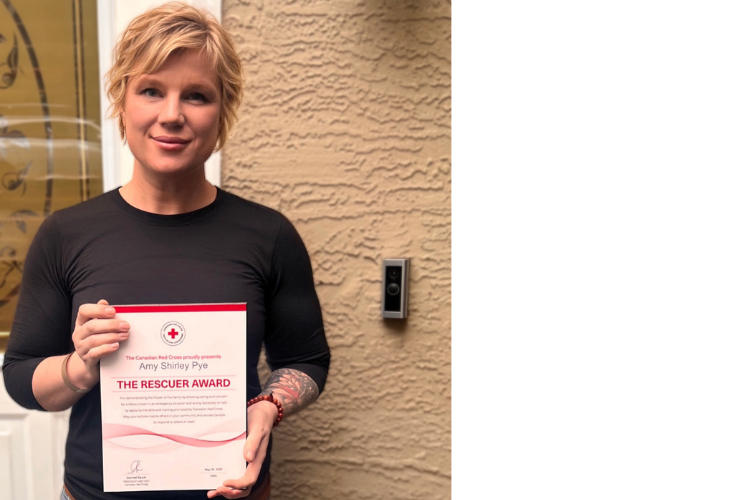
Amy Pye holds her Canadian Red Cross Rescuer Award outside her Nanaimo home where she answered a late-night call for help that saved a neighbour's life.
On a June night in 2026, Amy was in bed asleep when the doorbell rang, waking her. Through the doorbell camera, Amy saw a frightened 12-year-old boy who was desperately seeking help for his father. He had already knocked on three other doors before trying Amy’s, but no one had answered.
Amy quickly got up, grabbed her phone and followed the boy a few houses up the hill to his home. There, she found his father unresponsive and lying face down on the bathroom floor.
What to do when someone is unresponsive
Amy immediately got out her phone and called 911. While they waited for paramedics, Amy followed the emergency dispatcher’s instructions, rolled the man onto his back and began performing CPR (cardiopulmonary resuscitation).
Bystander CPR is performed by someone at the scene before paramedics arrive. The bystander does chest compressions to keep blood circulating to the brain and other vital organs while waiting for professional help. Watch this video on how to perform chest compressions.
Amy recalls, “The dispatcher counted with me through the compressions on speakerphone. I could feel myself getting tired. She told me to shift my weight and I just kept going.”
How Amy’s CPR skills helped
Amy remained calm, called for help and followed CPR instructions, but she also drew on skills she learned as a member of an Air Cadets first aid team and the Naval Reserve. All of this helped her remain focused on assisting her neighbour and reassuring his son. She asked the boy to watch for the ambulance and continued chest compressions until the paramedics arrived.
Why bystander CPR matters
Survival chances for the person needing CPR decrease by 10-15% every minute they don’t receive it1. Even untrained bystanders can help by performing compressions-only CPR (also called hands-only CPR). Luckily, that’s exactly what Amy did.
“I just remember hearing the sirens and feeling relieved that they were going to take over,” Amy says. “There were probably six or seven paramedics who came rushing in, tapped me on the shoulder and said, ‘Okay, we're taking over.’”
The paramedics brought an automated external defibrillator (AED) with them and used it to scan the rhythm of the man’s heart. It recommended a shock. After delivering the shock, the paramedics transported the man to the hospital for further care. Without Amy’s bystander CPR, the man might not have survived long enough to receive professional care.
Bystander AED use, in addition to CPR, increases survival chances even more. Watch this video on how to use an AED
Emergency preparedness builds community safety
Looking back, Amy believes several small circumstances came together that night to make this life-saving rescue possible.
“My daughter was away, I was home, my phone was charged, and my doorbell camera happened to be working,” she says. “Everything lined up.” But none of these things would have mattered without Amy’s willingness to step in and help.
The impact of her story has extended beyond the rescue itself, inspiring others to better prepare for emergencies.
“The ripple effect has been huge,” she says. “It's sparked conversations with my daughter about emergencies, and even in the community. Some people signed up for CPR training after hearing about what happened.”
Two weeks after the rescue, Amy took a CPR training herself and received certification. CPR training teaches you complete CPR skills and builds your confidence to act without waiting for instructions. Amy’s experience highlights how CPR skills can help people respond during unexpected emergencies.
Be ready to provide bystander CPR and help save a life like Amy did: Take a CPR course
About the Rescuer Award
In 2026, Amy was nominated for and received a Canadian Red Cross Rescuer Award in recognition of her life-saving actions. This award honours individuals who use first aid skills, training, quick thinking, and courage to help save a life.
Does this sound like someone you know? Nominate them for a Canadian Red Cross Rescuer Award.
November is CPR Month
The Canadian Red Cross urges all Canadians to learn how CPR can save lives and to get trained. Learn more about CPR Month, access free resources and more
Related articles
- How CPR training and an AED helped save a life in Oshawa, Ontario
- Breaking ribs and other CPR fears
- Debunking myths around performing CPR
- How CPR differs from what you see in movies