

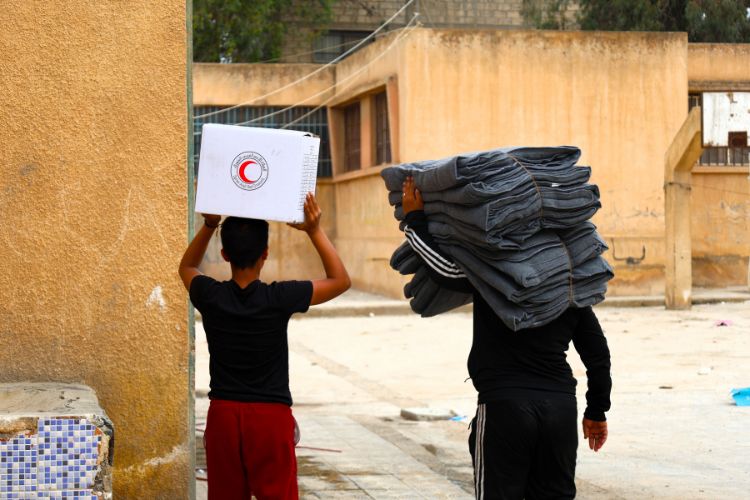
Photo: Syrian Arab Red Crescent
As conflicts around the world continue to be covered in news and shared across social media feeds, young people in Canada are asking difficult questions about war, displacement, and humanitarian crises. Increasingly, educators are being asked to help students navigate these conversations — often without enough tools or support.
For the Canadian Red Cross, the answer is not to avoid these conversations. It is to equip young people to engage with them safely and critically through humanitarian education.
With over 800 educators in our Humanitarian Education Network, students can meaningfully have these conversations. In many cases, they are already having them.
It’s our goal to guide and empower students in these discussions with our humanitarian education workshops and lesson packs for educators, informed and designed by subject matter experts like humanitarian practitioners, protection workers, legal experts, teachers, and youth.
Canadian Red Cross Humanitarian Education Youth Action Summit
This commitment is at the centre of the Canadian Red Cross Humanitarian Education Youth Action Summit — an annual initiative bringing together students, educators, and humanitarian experts from across the country to explore the human consequences of armed conflict and the importance of international humanitarian law (IHL).
The summit is more than an event. It’s a space where youth learn from one another, ask difficult questions, and turn learning into action.
A national space for youth action
The Online Humanitarian Education Youth Action Summit is part of the Canadian Red Cross’ broader Humanitarian Education Program, which delivers IHL education across Canada.
The summit, delivered in partnership with the Centre for Global Education, connects secondary school students and teachers with humanitarian practitioners, academics, and speakers with lived-experience to discuss themes such as displacement, protection of civilians, children associated with armed conflict, sexual and gender-based violence, and the protection of the environment during armed conflict.
The summit also provides additional classroom learning about these themes with interactive resources such as Forced to Fight, a choose-your-own-path digital learning experience developed by the Canadian Red Cross.
Forced to Fight helps students explore the realities young people face during conflict. Through stories involving forced displacement, Indigenous communities, recruitment of children by armed forces or armed groups and survivors of violence, students learn about humanitarian dilemmas and the legal protections intended to reduce suffering in war.
The resource has reached over 21,000 users globally to date.
As participants of the summit, students aren’t just receiving information provided by the classroom resources and guest speakers, they’re reflecting on it, discussing it, and sharing it with others.
One student who participated in the summit described how learning about IHL changed their perspective on armed conflict:
“Learning about humanitarian laws brings conflicts closer to home for me because it affects people that are just like us,” the student said. “It’s kind of comforting to know how we can protect people like them.”
Another student explained that learning about IHL inspired them and their classmates to organize presentations for younger students in their community.
“IHL brings a certain comfort knowing that there are actions and laws in place,” the student said. “Because of that, this group decided that it would be really great to create a presentation … talking about the interactive online website Forced to Fight.”
Why peer-to-peer education matters
For the Canadian Red Cross, and all contributors and participants of the summit, one of the most important outcomes is students taking initiative to educate their peers about the importance of understanding and respecting IHL.
Teachers participating in Canadian Red Cross humanitarian education programming have repeatedly observed that students become more empathetic, globally aware, and motivated to act after engaging with humanitarian education lessons:
“Connecting to the stories of those affected by armed conflict convinced some students to organize activities and educate others on protections under IHL,” one teacher wrote.
Another teacher reported that the lessons helped students move beyond the “filter bubbles” created by social media and better understand global realities.
As for students, some have identified storytelling and sharing real-world experiences as some of the most impactful aspects of the summit:
“I liked how many people that were there had real life experience in the situations they were discussing,” one participant shared following the 2023 Youth Action Summit. “Made it feel more real.”
This kind of meaningful engagement with peers and subject matter experts matters at a time when many classrooms are struggling to navigate polarization and emotionally charged discussions about global events, like armed conflicts and related humanitarian concerns.
Reflections on the past two years
Over the last two years, participation in humanitarian education activities and digital learning tools has continued to grow.
Teachers report increasing student engagement, stronger classroom discussions, and greater student-led action following humanitarian education activities.
Some students have organized awareness campaigns, developed social action projects, or explored future careers in humanitarian work and international law.
Teachers have also emphasized how relevant these discussions feel to students living in a world shaped by constant exposure to conflict through news and social media.
“The students are interested in learning about something that seems ‘real’ to them and relates to conflicts they are seeing in the news,” one teacher noted.
Building empathy and understanding
At its core, humanitarian education is about helping young people understand both the rules designed to limit suffering in war and the human stories behind them.It encourages students to think critically about what they see online, challenge dehumanizing narratives, and recognize the humanity of people affected by armed conflict.
Turning knowledge into humanitarian action
Learning about humanitarian issues is only the first step—real change begins when youth put that knowledge into action. Whether a student, educator, or simply someone who wants to make a difference, there are many ways to get involved:
-
Learning: Start by exploring Canadian Red Cross Humanitarian education resources, including the Forced to Fight interactive learning experience, and encourage your school or teacher to participate in future humanitarian education programming and the Youth Action Summit. Read books, watch documentaries, and listen to podcasts featuring people with lived experience of conflict and displacement.
-
Participating in ongoing dialogue: Share what you've learned with classmates, organize a classroom discussion or awareness campaign, and use your voice to promote empathy, respect, and informed dialogue in your community.
-
Get involved: Encourage your school to participate in the Youth Action Summit. Explore careers or volunteer opportunities in humanitarian work, international law, public health, or emergency management.
-
Advocate: Promote dignity, protection and respectful dialogue in your school and online communities.
Humanitarian action doesn't always begin on the front lines—it often begins with a conversation, in a classroom, or a decision to learn more. By taking these small but meaningful steps, young people can help build more compassionate, informed, and resilient communities while becoming the next generation of humanitarian leaders.
To learn more about IHL and upcoming events, visit: International Humanitarian Law | Canadian Red Cross.
Educators and students can also access additional humanitarian education content through our online video resources, including:
-
Humanitarian Education Webinars (YouTube playlist)
-
IHL Academic Conferences and Events (YouTube playlist)