

When most people think about emergency response, they picture the moment disaster strikes.
The rising water. The evacuation order. The dramatic images on the evening news.
But preparedness can look very different.
Sometimes preparedness looks like answering an email.
Answering the call to support flood preparedness
I had just returned from my wedding ceremony and a family trip in China when a Canadian Red Cross call for action landed in my inbox.
Communities in Manitoba were preparing for potential flooding, and support was needed. The request felt urgent. People were being asked to deploy immediately.
Within hours, things changed on a dime. There was a whirlwind of logistics: I coordinated university group projects for my master's program, rearranged work commitments, packed supplies, and waited anxiously to hear whether I would be deployed.
When the call finally came, it felt both exciting and overwhelming. There is never a perfect time to respond to an emergency—only people doing their best to make room for one.
A few days later, I was on my way to Manitoba.
As my plane descended into Winnipeg, I looked out the window at endless flat fields streaked with late-season snow.
The landscape looked peaceful. You would never guess how much preparation was already underway beneath that calm surface.
Meeting preparedness face-to-face
Our destination was Peguis First Nation, one of the largest First Nations communities in Manitoba. The Canadian Red Cross had worked with Global Medic to preposition supplies needed to protect the community from flooding.
During our briefing, we learned that the community had experienced devastating floods in the past. Homes had been damaged. Families had been displaced. Flooding was not a new threat here.
That was what struck me most: the gravity and realness. The destruction was right in front of me… not behind a phone screen or on the news. I wasn’t seeing it in the comfort of my own home where it felt far away. It was here and now. I remember thinking, “we’re in the real world now.”
As volunteers and staff gathered for orientation, emergency plans were reviewed, safety procedures discussed, equipment distributed, and work assignments organized.
Calls interrupted presentations as conditions changed in real time. Trucks moved constantly around active worksites. Community leaders, emergency personnel and Red Cross teams coordinated next steps.
It wasn't glamorous, but it was essential.
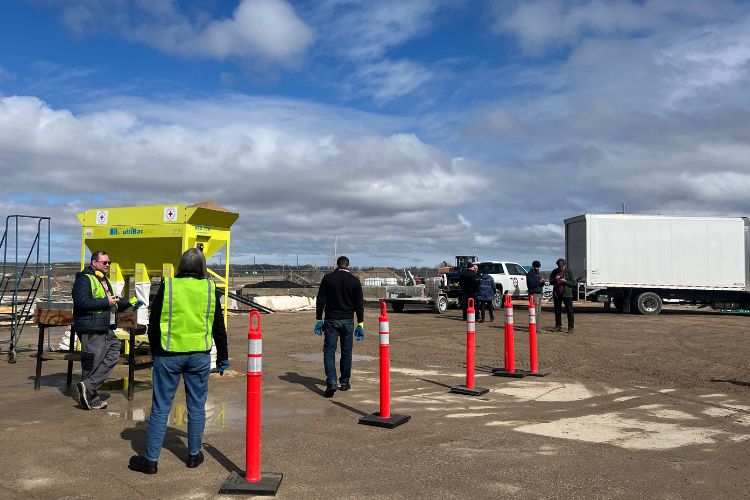
Photo: Canadian Red Cross
Building protection one sandbag at a time
Soon, dozens of us were standing together in a winding line, passing sandbags.
At first, we struggled.
People were spaced too far apart. Instructions became tangled. Some parts of the line shouted "slow down" while others yelled "stop." Sand leaked everywhere. Into our boots. Into our gloves. Into our mouths.
Then something changed.
We found our rhythm.
One person passed a sandbag to the next. Then the next. Then the next.
Warnings travelled down the line.
"Heavy."
"Leaking."
Eventually the descriptions became more creative.
"Baby."
"Big baby."
"Regular baby."
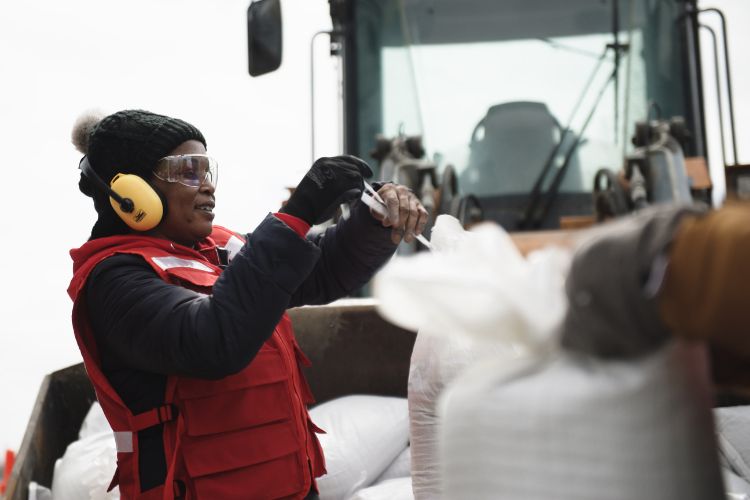
Photo: Adam Tadros / Canadian Red Cross
A little humour can go a long way when you're carrying sandbags for hours. What looked like a simple line of people was actually something much bigger: community preparedness in action.
Every sandbag placed before a flood arrives is a small act of protection.
Every barrier strengthened is time gained.
Every volunteer trained and deployed is another pair of hands helping communities prepare for what may come next.
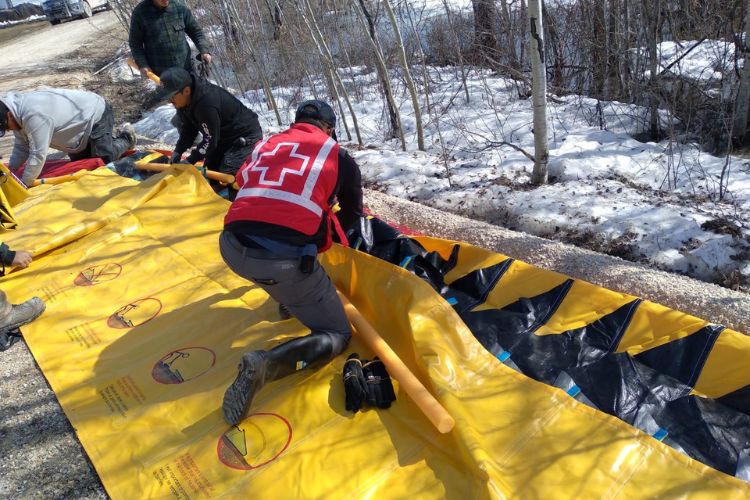
Photo: Vishva Ragunathan / Canadian Red Cross
The part preparedness shares with response
One lesson stayed with me throughout the deployment. The same thing that makes emergency response effective also makes preparedness effective:
People.
Not equipment. Not plans. Not sandbags.
The community members welcoming us onto their land, and working with us to help prepare the community for flooding.
The volunteers who lent me a jacket when I couldn't find one.
The colleague who offered me a Red Cross hat after seeing my improvised sun hat made from paper and a toque.
The site managers coordinating dozens of moving pieces.
The teams who showed up each day ready to work, tired but determined.
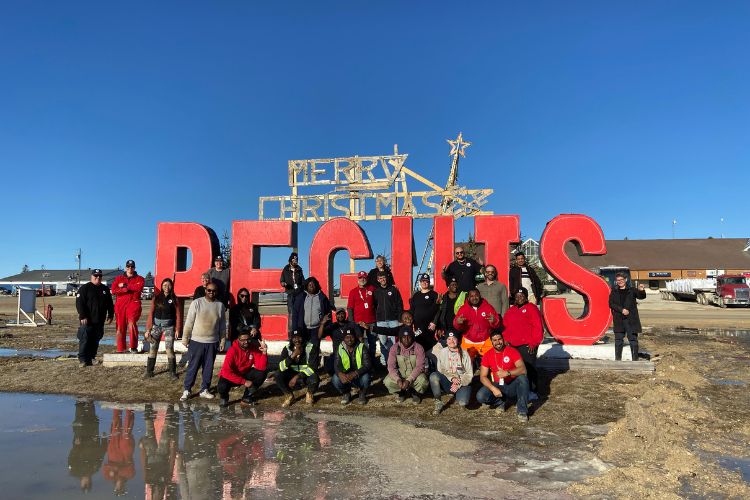
Photo: Canadian Red Cross
Preparedness is often described through logistics, forecasts and mitigation plans. But on the ground, it feels remarkably human.
It looks like conversations on long bus rides.
Shared meals. Inside jokes. People looking out for one another.
Why preparedness matters
After days of work, we were helping finish protective barriers around a home. As the shift wrapped up, colleagues made one final sweep of the property, collecting garbage, securing materials, and ensuring nothing was left behind.
Nearby, a Peguis First Nation community member thanked a member of our team.
I remember pausing for a moment and looking at the wall of sandbags we had built together.
I have always wanted to help people. It's what brought me to the Canadian Red Cross and what motivated me to answer the call to support Peguis First Nation. In that moment, I felt a deep sense of purpose. Not because the work was finished, but because our team had been able to contribute something meaningful.
The floodwaters had not yet arrived. The uncertainty was still there. I felt concern for the families who would soon be facing whatever came next.
But alongside that concern was hope. Hope that the barriers we'd built would help lessen the damage. Hope that our efforts would give residents one less thing to worry about. Hope that, when the community needed support, they would know they were not facing it alone.
This is a part of the Canadian Red Cross mission that many people never see
Disaster preparedness doesn't often make headlines, but it helps communities face uncertainty with greater confidence. It helps reduce risk and ensure that when emergencies happen, communities are not facing them alone.
For donors, this is the impact your generosity makes possible.
Not just support during a disaster.
Not only support after a disaster.
Support before a disaster, too.
Because preparedness begins long before the water rises.