

As I write this on a frigid winter’s day in Ottawa, it’s easy as a Canadian to relate to the cold in Ukraine, where winter conditions are made far more dangerous by years of conflict.
This winter is proving to be the hardest Ukraine has faced since the escalation of the armed conflict in 2022. Communities are grappling with damaged homes and essential infrastructure, including regular power outages, as well as the stress of years of conflict, displacement, and uncertainty.
In December 2025, I travelled to Ukraine to support the response. I had the chance to see the programs firsthand, meet the Ukrainian Red Cross Society staff and volunteers who deliver them, and better understand how needs continue to evolve in this long-term humanitarian crisis.
A humanitarian crisis shaping every-day life across Ukraine
The armed conflict has had wide-ranging impacts across Ukraine. Homes and public infrastructure have been damaged or destroyed. Electricity, heating, and water supplies are frequently disrupted, even in the middle of winter.

Photo: Angela Hill / Canadian Red Cross
Beyond the visible damage, the toll on people’s mental health is immense. Years of living with insecurity and stress have created urgent needs for mental health and psychosocial support that will likely continue for years to come.
With the humanitarian crisis now in its fourth year, the health and shelter programs the Canadian Red Cross supports through the Ukrainian Red Cross Society remain essential. Homes continue to be damaged by attacks. Families who fled from front-line regions are still rebuilding their lives in new communities. People need ongoing support to cope with the psychosocial impacts of conflict.
Reaching communities in Ukraine that are often overlooked
While Canadian Red Cross support reaches programs across the country, much of our work is focused on the Cherkasy and Poltava Oblasts in central Ukraine. These regions have welcomed large numbers of people who have been displaced from other parts of the country. While they may be geographically distant from the front lines, the humanitarian needs in these communities remain significant.
These regions are also largely underserved by international humanitarian actors. This makes the Red Cross’s presence there especially critical. Through its nationwide network of staff and volunteers, the Ukrainian Red Cross Society is the organization best positioned to identify needs quickly and respond in a way that is rooted in local communities.
In Sofiivka, Cherkasy Oblast, I met a man named Hryhorii whose home was damaged by an attack in October. Thanks to a Red Cross cash assistance grant, he was able to repair the damage before winter set in. It was a modest intervention in financial terms, but for him, it meant safety, dignity, and the ability to remain in his home as temperatures dropped. I also met Valentyna, the mayor of Sofiivka who told me that without the Ukrainian Red Cross Society, the local government would struggle to support people like Hryhorii. She expressed her gratitude, directly to people in Canada, for their solidarity in these difficult times.
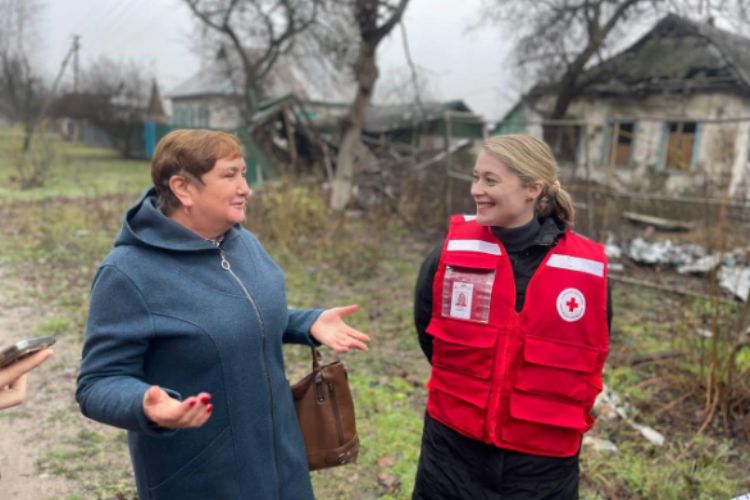 Discussing Red Cross support with Valentyna Chernets, mayor of Sofiivka, Ukraine. Photo: Ukrainian Red Cross Society
Adapting to a winter like no other
One of the most striking aspects of this visit was seeing how the Ukrainian Red Cross Society continues to adapt as needs change. The Red Cross plans for winter every year, but this one is different.
Massive and repeated disruptions to electricity, heating, and power across Kyiv and many other cities have compounded already difficult living conditions. In response, the Ukrainian Red Cross Society has scaled up winterization activities, working closely alongside government emergency services to meet urgent needs. This includes providing essential relief items, supporting warming centres, and helping communities cope with prolonged power outages in freezing conditions.
The ability to adapt and scale rapidly is essential in a humanitarian crisis like this, and it is something the Ukrainian Red Cross Society does every day.
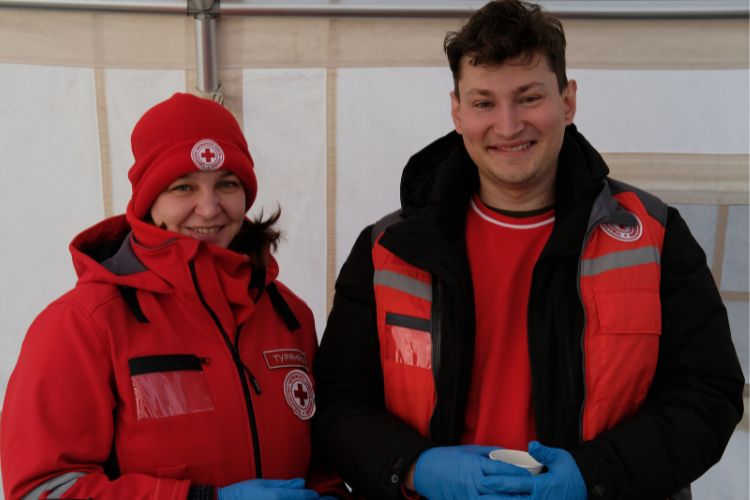 Ukrainian Red Cross Society personnel Tetiana Turianytsia and Vitalii Vyshnyk serve cups of hot tea and coffee at a Red Cross warming centre in Poltava. Photo: Angela Hill / Canadian Red Cross
Looking ahead: supporting veterans and their families
Adaptation is also about looking beyond immediate response. One area where the Ukrainian Red Cross is increasingly focusing its efforts is supporting veterans and their families.
This is a large and growing need in Ukraine and will be a central component of the country’s recovery in the years ahead. Ukraine is entering a period in which veterans and their families will represent a significant and growing segment of society. Their needs are complex and interconnected: physical rehabilitation, mental health and psychosocial support, reintegration into family and community life, and support navigating services and pathways back into the workforce.
The Ukrainian Red Cross Society currently supports veterans in many of these areas, including providing entrepreneurship grants, supporting reintegration retreats and providing mental health support, and are working to expand their support in this area to meet the growing needs of veterans and their families. With its nationwide presence, deep community roots, experience in community-based mental health programming, and partnerships with local authorities, the Red Cross is uniquely positioned to support community-based mental health programming.
Adapting Canadian Red Cross support in Ukraine
The Canadian Red Cross is also continuing to adapt to changes in the context. In the early stages of the response, our work relied heavily on international delegate support. Today, our team on the ground in Ukraine is made up almost entirely of Ukrainian professionals, supported by one international staff member.
This shift reflects both the strength of local expertise and our commitment to supporting locally led humanitarian action. Ukrainian colleagues bring essential context, knowledge, and relationships that strengthen the Canadian Red Cross response and ensure it remains relevant as conditions evolve.
Humanitarian support in Ukraine remains vital
Four years since the escalation of the conflict, uncertainty remains a defining feature of this humanitarian crisis. No one can say what the coming months or years will bring. What is clear is that humanitarian needs persist, and support remains vital.
As the Canadian Red Cross, we continue to adapt our support to the Ukrainian Red Cross Society, working together to respond to immediate needs while also preparing for the long road to recovery that lies ahead.
My visit in December reinforced what I have seen throughout this response. Even in the most difficult circumstances, local Red Cross staff and volunteers, and the communities they support, continue to show extraordinary determination. Our role is to stand with them—today, tomorrow, and for as long as that support is needed.