

University of Alberta Law Students Discuss Climate Change and Armed Conflict
Climate change and armed conflict is an increasingly urgent issue. Yet, it is complex.
The Canadian Red Cross and the University of Alberta’s Law Students for Human Rights collaborated to bring together experts, students, and members of the public to demystify this topic and its connection to international humanitarian law (IHL).
The IHL conference, held in Edmonton, featured a group of multi-disciplinary experts who presented research on the issue to spark discussion among audience members.
“We want people to reflect on why it’s important to have rules during armed conflict, including rules that protect the environment,” says Red Cross IHL Coordinator Karyn Stone. “Climate change is impacting or will impact us all, but people living in conflict-affected environments are especially vulnerable,” continues Karyn.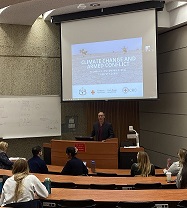
Additionally, the organizers hoped the conversation would pique the interest of students in attendance.
“Exposing students to the breadth and depth of legal study was a main goal,” says Michael Bradley from the University of Alberta’s Law Students for Human Rights “Hopefully, someone heard something during the event that interested them and makes them want to research it.”
“There are a lot of directions you can head in with a law degree,” says Karyn. “We would love to see some IHL experts in the next generation of law school graduates.”
Overall, the event was a resounding success as audience members spoke highly of the presenters and the discussion that occurred.
Kyla, a third-year law student at the University Alberta said, “it was fascinating to hear some of the conflicting options about changing some of our current laws.”
Angeline, a PhD candidate in the University of Alberta’s Sociology department, said the IHL conference left her “with a lot to consider for the place of legislation in governing armed conflicts and climate change.” Angeline also expressed that “many important conversations came up about how climate change exacerbates existing instability.”
The Red Cross strives to provide engaging educational opportunities on the many timely topics related to IHL. The Red Cross is thankful to work with partners like the University of Alberta’s Law Students for Human Rights on events like this.
Find out more about the International Humanitarian Law Program at the Canadian Red Cross
The conference was held November 3, 2022, at the University of Alberta.
The Canadian Red Cross and the University of Alberta’s Law Students for Human Rights collaborated to bring together experts, students, and members of the public to demystify this topic and its connection to international humanitarian law (IHL).
The IHL conference, held in Edmonton, featured a group of multi-disciplinary experts who presented research on the issue to spark discussion among audience members.
“We want people to reflect on why it’s important to have rules during armed conflict, including rules that protect the environment,” says Red Cross IHL Coordinator Karyn Stone. “Climate change is impacting or will impact us all, but people living in conflict-affected environments are especially vulnerable,” continues Karyn.
Additionally, the organizers hoped the conversation would pique the interest of students in attendance.
“Exposing students to the breadth and depth of legal study was a main goal,” says Michael Bradley from the University of Alberta’s Law Students for Human Rights “Hopefully, someone heard something during the event that interested them and makes them want to research it.”
“There are a lot of directions you can head in with a law degree,” says Karyn. “We would love to see some IHL experts in the next generation of law school graduates.”
Overall, the event was a resounding success as audience members spoke highly of the presenters and the discussion that occurred.
Kyla, a third-year law student at the University Alberta said, “it was fascinating to hear some of the conflicting options about changing some of our current laws.”
Angeline, a PhD candidate in the University of Alberta’s Sociology department, said the IHL conference left her “with a lot to consider for the place of legislation in governing armed conflicts and climate change.” Angeline also expressed that “many important conversations came up about how climate change exacerbates existing instability.”
The Red Cross strives to provide engaging educational opportunities on the many timely topics related to IHL. The Red Cross is thankful to work with partners like the University of Alberta’s Law Students for Human Rights on events like this.
Find out more about the International Humanitarian Law Program at the Canadian Red Cross
The conference was held November 3, 2022, at the University of Alberta.
Regions
NationalAlberta
British Columbia
Manitoba
New Brunswick
Newfoundland and Labrador
Northwest Territories
Nova Scotia
Ontario
Prince Edward Island
Quebec
Saskatchewan
Nunavut
Yukon
Worldwide
Africa
Americas
Asia
Middle East and North Africa
Europe
Topics
Community HealthEmergencies and Disasters in Canada
Emergencies and Disasters Worldwide
Finding Family
First Aid and CPR
International Humanitarian Law
Migrant and Refugee Services
Our Impact on the Ground
Philanthropy News
Violence, Bullying and Abuse Prevention
Volunteer
Water Safety
Youth
Indigenous Communities
Maternal Newborn and Child Health
Refugee Crisis
Refugee Arrival