

As a mother of three school-age children, I am used to the reassuring routine of school life – packing lunches, checking homework, listening to playground stories. It’s a rhythm that feels stable, almost guaranteed.
That certainty felt different when I visited a primary school in Jamaica this past January, just over two months after Hurricane Melissa made landfall in October 2025.
At the time, I was in the country as part of a month-long deployment with the emergency medical clinic team led by the Canadian Red Cross, supporting clinical services alongside local health teams.
The school I visited was located near one of the health centres where we were working. With many children regularly coming through the clinic, I became curious about how the nearby school had been affected by the hurricane and whether classes had resumed. After arriving at the school and speaking with the principal, they agreed to show me around and share how the storm had affected students, teachers, and daily school life.
While our mandate did not include education, it was impossible to ignore how closely linked children’s health, well-being, and access to learning had become in the aftermath of the storm. Across the community, there was a clear determination to rebuild and create stability for children again.
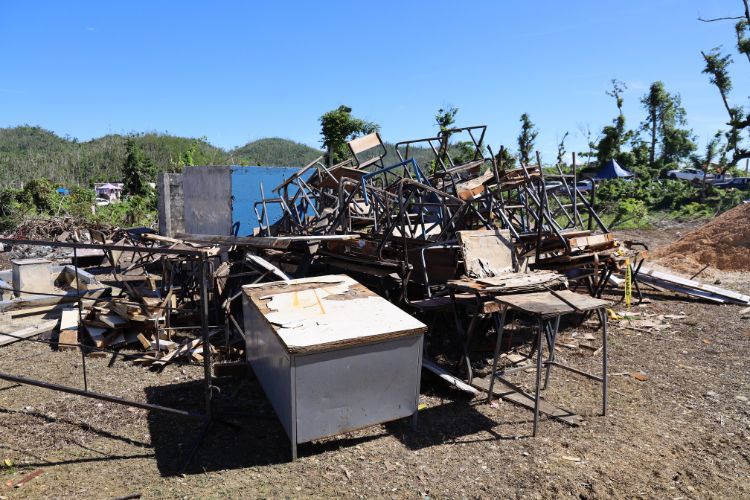
Photo: Thaïs Martín Navas, Canadian Red Cross
How Hurricane Melissa Changed a School Community
Before the storm, the school had been much like any other. “We began school at 8:30 a.m. and classes ended at 3:00 p.m. Everything was normal,” the principal told me. Classrooms were full, routines were established, and over 170 students attended daily.
Then Hurricane Melissa hit.
The principal described the storm simply as “a monster” — the worst they had ever experienced. By the time I arrived, the school building had been reduced to a shell. Roofs were torn off, interiors exposed, sanitation facilities damaged, and electrical wiring ripped apart.
Hurricane Melissa damaged this primary school in Jamaica in October 2025. When this video was filmed two months later, classes had resumed in temporary tents nearby.
The mango, coconut, and apple trees that once shaded the schoolyard were gone. In a video walkthrough I captured, classrooms stand open to the sky, debris where they once stood. It was difficult not to imagine children sitting at their desks there just a few months earlier.
And yet, school had resumed – just not as we know it.
Continuing Learning in Temporary Classrooms
Lessons were taking place under durable, high-performance tents donated by the United Nations International Children’s Emergency Fund (UNICEF). Each tent was divided into two makeshift classrooms. Space was limited, and noise carried easily. Activities that once defined classroom learning had to be adapted or set aside.
With only a few classes able to run at once, students attended school on a rotation basis, coming in a few days each week and continuing to learn from home on others.
The disruption extended far beyond the school grounds. Many children had been out of school for more than two months before classes were able to resume. Some families had been displaced from their homes and were living with relatives or in temporary arrangements. Others had not returned to school at all.
Reopening the school was about more than continuing lessons. For many students, returning to a classroom – even a temporary one – meant regaining routine, connection, and a sense of stability.
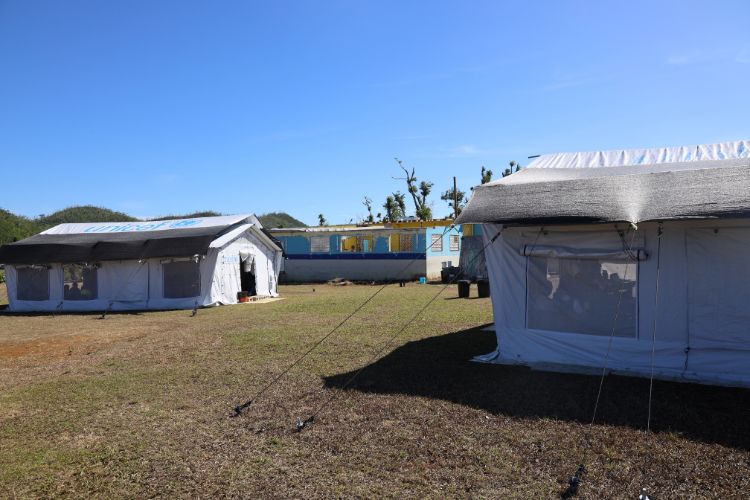
Photo: Thaïs Martín Navas, Canadian Red Cross
The emotional impact was immediate when students first returned. “Some of them were a bit down, some of them would cry,” the principal shared, recalling those early days. As a mother, that part stayed with me. I could easily imagine my own children trying to focus on math or reading while carrying fear, loss, or uncertainty.
Over time, many students began to regain a sense of routine and stability. “They are upbeat now, and they are ready for teaching and learning,” the principal said.
The Challenges of Learning in Temporary Classrooms
Although classes had resumed, the learning environment brought practical challenges. With tents divided into shared spaces and limited facilities, maintaining conditions for effective learning was not always straightforward.
The school’s canteen, which once provided hot meals, was no longer operational. Families were asked to send food with their children, but this was not always possible.
Without electricity, many households could not refrigerate food or safely store perishables, making it difficult to prepare lunches in advance. Combined with the broader financial strain following the hurricane, families faced extra pressure while already adapting to new realities.
Inside classrooms, teachers adjusted daily, finding ways to keep students engaged while teaching in challenging conditions. The shared tents offered limited facilities and privacy, creating additional barriers for both students and staff.
For older students, especially girls, navigating a school day in temporary classrooms comes with added challenges when privacy and sanitation facilities are limited. This can affect their comfort, including managing menstrual health and hygiene needs.
Teachers, too, had been deeply affected by the hurricane but were continuing to support their students. “We have two members of staff that don’t have any house right now,” the principal told me.
A Community Keeping School Life Moving Forward
Beyond the classroom, daily life remained complex. Months after the hurricane, the community was still without consistent access to reliable drinking water, electricity, and internet. Water was trucked in daily and stored in tanks, which also served the surrounding community. And yet, what stood out most was not the loss. It was the determination to continue.
“Parents and students are very grateful,” the principal told me, “that although we do not have a dwelling for school, we try our best to allow the students to come out so that teaching and learning can take place.”
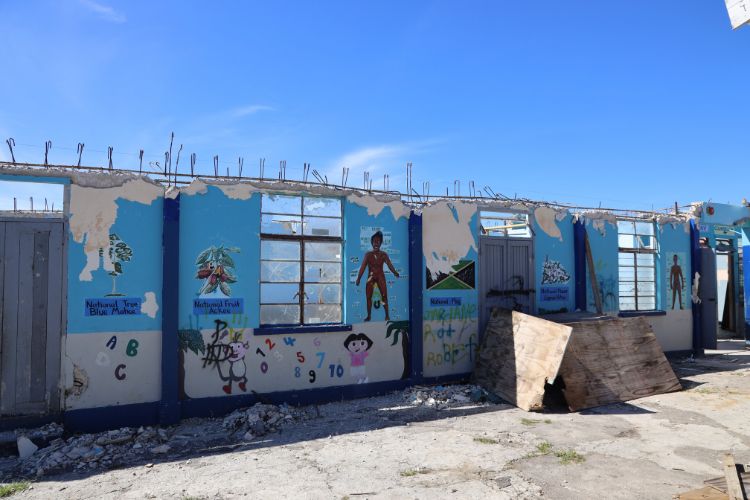
Photo: Thaïs Martín Navas, Canadian Red Cross
As I walked through the school, that commitment was visible: children focusing on their lessons under canvas tents, teachers navigating noise and space constraints, and a school community refusing to pause education despite everything.
Reconstruction of the school buildings is underway, with efforts to reinforce structures and replace roofs with more durable materials, alongside broader recovery work taking place across affected communities in Jamaica. But timelines remain uncertain. For now, learning continues in temporary classrooms.
The visit stayed with me long after I left Jamaica. It reshaped how I think about the assumptions we carry – that schools will open, that classrooms will be there, that routines will hold.
In this community, much of that certainty was taken away. What remained was something more enduring: the determination to rebuild, to teach, and to learn, no matter the circumstances.
As Jamaica marks Child Month in May – a time dedicated to celebrating and supporting children – this school community’s efforts are a powerful reminder that learning does not stop when buildings are lost. It continues wherever there is space, support, and the will to carry on.